
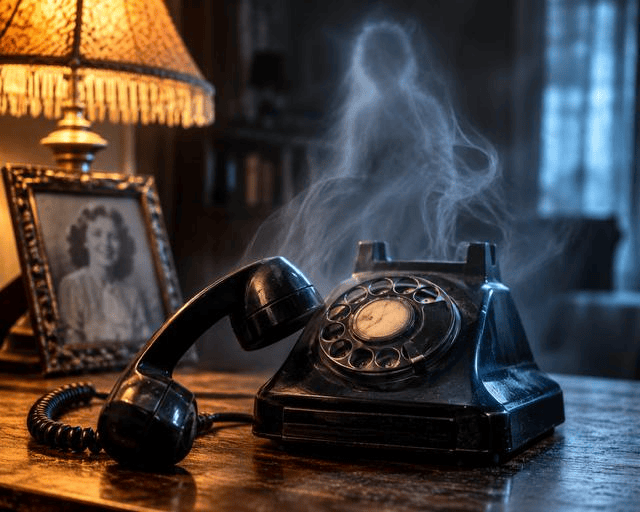
When the Phone Rings, Who—or What—is on the Other End?
Imagine sitting quietly at home when your telephone rings. You answer it, and before you can say much more than hello, you hear a familiar voice.
It belongs to someone you love.
Someone who died months ago. Perhaps years ago.
The voice sounds unmistakable. The caller knows your name. They speak in a familiar tone, perhaps asking how you are or offering a few reassuring words. The conversation may last only seconds before the connection fades, the voice disappears, or the line goes silent.
You hang up, trying to understand what just happened.
Was it a mistake? A strange telephone malfunction? Your imagination playing tricks on you?
Or did someone who has passed away just find a way to reach you?
It sounds like something from a supernatural thriller. Yet reports of unexplained telephone calls involving deceased individuals have been collected and examined by paranormal researchers for decades.
And surprisingly, this phenomenon has received far less public attention than haunted houses, apparitions, and traditional ghost sightings.
A Phenomenon With a History
In 1979, paranormal investigators D. Scott Rogo and Raymond Bayless published a book titled Phone Calls from the Dead: The Results of a Two-Year Investigation Into an Incredible Phenomenon.
Their work focused on reports from people who believed they had received telephone calls from individuals who were already deceased.
What made their investigation particularly interesting was that the callers were not always immediately recognized as being dead.
In some accounts, the recipient believed they were having an ordinary conversation with a living friend or relative. Only afterward did they discover that the person had died before the call supposedly took place.
Other reports described brief calls in which the deceased person seemed to communicate only a few words before the connection ended.
Some accounts involved people who were already aware of the caller’s death.
The investigators organized these experiences into different categories, attempting to identify patterns and understand what witnesses were describing.
They weren’t simply collecting stories about ghosts. They were investigating an unusual form of alleged communication involving one of the most ordinary pieces of technology in our homes.
The Calls That Make You Wonder
One particularly intriguing aspect of these accounts is how ordinary the conversations reportedly sound.
There are stories of people answering their phones and hearing a deceased relative speak as though nothing unusual had happened.
In other reports, the caller appears to have a specific reason for making contact.
A message. A warning. A simple expression of reassurance.
One account described in the historical research involved a woman who reportedly received an urgent call for help from a friend at approximately the same time that friend was being pronounced dead at a hospital.
These accounts are difficult to independently verify, but they raise fascinating questions about perception, memory, coincidence, and the possibility of communication beyond death.
Why would an unexplained experience take the form of something so familiar?
Why a telephone?
And why would the communication often be so brief?
What Happens When the Connection Ends?
Some reported experiences have a particularly strange detail: the caller doesn’t seem interested in carrying on a lengthy conversation.
The voice may deliver a short message, repeat a few words, or simply acknowledge the person answering.
Then the call ends.
Other accounts describe a voice that becomes faint or indistinct before disappearing.
Researchers have also collected reports of calls in which the recipient did not initially know the caller was deceased.
These experiences are especially intriguing because the recipient may have no reason to interpret the conversation as paranormal until learning what happened.
Of course, a remembered conversation can be influenced by grief, expectation, and the passage of time. That makes independent documentation especially important.
Still, the recurring descriptions have kept the subject alive among paranormal investigators.
Has Anyone Seriously Studied This?
Yes.
The investigation did not end with Rogo and Bayless.
In 2012, researcher Callum E. Cooper published Telephone Calls from the Dead: A Revised Look at the Phenomenon Thirty Years On.
Cooper revisited the earlier research, examined additional accounts, and considered alternative explanations.
In 2014, he also published a paper in the Journal of Parapsychology titled “An Analysis of Exceptional Experiences Involving Telecommunication Technology.”
The paper examined 50 spontaneous accounts involving unusual experiences with telephone technology, including reports involving deceased individuals.
The research explored the relationship between these experiences and bereavement, while acknowledging that psychological explanations and paranormal interpretations both deserved consideration.
This is an important distinction.
There is a difference between documenting that someone experienced something extraordinary and proving that the experience came from a deceased person.
At present, there is no established scientific evidence demonstrating that the dead can communicate through telephone systems.
But the reports themselves are part of a documented area of paranormal research.
Could There Be an Ordinary Explanation?
There are several possibilities worth considering.
Grief can profoundly affect how people experience the world. A person who has recently lost someone may hear a familiar voice, experience a vivid dream, or feel the presence of the individual they miss.
Telephone technology can also produce unexpected sounds, crossed connections, distorted audio, and other unusual experiences.
Memory is another consideration. A conversation remembered years later may not be identical to what was originally heard.
And then there is coincidence.
A call arriving at an emotionally significant moment might seem impossible, even when there is a natural explanation.
But what if a particular account contains details that the recipient could not reasonably have known or anticipated?
That is where careful investigation becomes important.
Witness accounts should be documented as soon as possible, telephone records examined when available, and independent witnesses interviewed separately.
The more information that can be verified, the more meaningful the investigation becomes.
What If the Technology Isn’t the Important Part?
Perhaps the most fascinating question isn’t whether a deceased person can somehow use a telephone.
Perhaps it is why these experiences seem to involve familiar methods of communication.
People report dreams, unexplained voices, familiar scents, and the sensation that someone they loved is nearby.
Telephone calls are another form of reported after-death communication.
Could the telephone simply be the setting in which an unusual experience occurs?
Or is there something about communication itself that we have yet to understand?
We should be careful not to confuse unanswered questions with proof. But we should also recognize that an unanswered question can be worth investigating.
The Next Time Your Telephone Rings
Most of us answer our phones without giving it a second thought.
We expect to hear a friend, a relative, a business, or perhaps an unwanted sales call.
We don’t expect to hear someone who is no longer alive.
Yet reports of these experiences have been collected for generations, and researchers have continued examining them.
Maybe there is a natural explanation for every one of them.
Maybe some experiences have been misunderstood, misremembered, or influenced by the deep emotional connections we maintain with those we have lost.
Or perhaps there are aspects of human experience that we have not yet learned how to explain.
I find myself returning to one question:
If someone you loved called you tomorrow, and you recognized their voice immediately, would you hang up—or would you stay on the line?
And perhaps an even more unsettling question:
What if the person on the other end wasn’t calling to tell you goodbye?
Some mysteries don’t begin with a knock at the door. Sometimes, they begin with a ringing telephone.
Research behind the article
These are the sources I’d retain for credibility and further investigation:
- D. Scott Rogo and Raymond Bayless (1979) — Phone Calls from the Dead. The original two-year investigation.
- Callum E. Cooper (2012) — Telephone Calls from the Dead. A later examination of the phenomenon.
- Callum E. Cooper (2014) — Peer-reviewed paper examining 50 unusual telecommunication experiences. Read the research paper.
- Society for Psychical Research — Review of Cooper’s research.
Written by,
Dawn Monforte

